
Air Quality
These resources and tools can help surface transportation professionals address air quality issues at the project and regional levels.
Home » Focus Areas » Air Quality
Featured
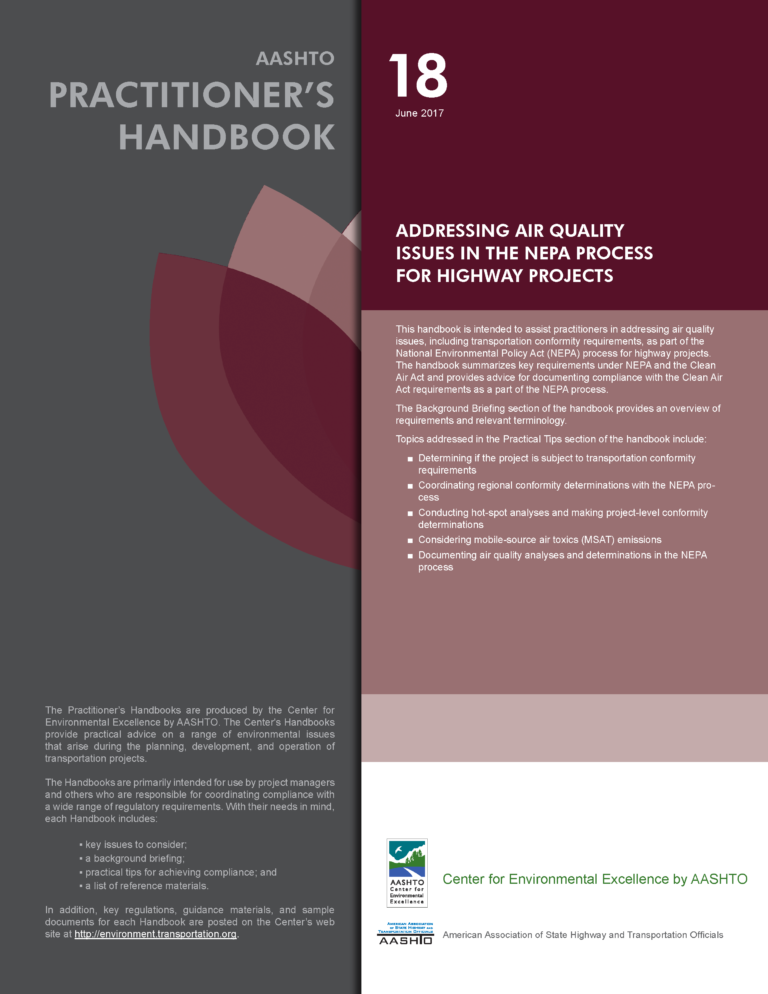
Addressing Air Quality Issues in the NEPA Process for Highway Projects Practitioner’s Handbook
This handbook is intended to assist practitioners in addressing air quality issues, including transportation conformity requirements, as part of the National Environmental Policy Act (NEPA) process for highway projects. The handbook summarizes key requirements under NEPA and the Clean Air Act and provides advice for documenting compliance with the Clean Air Act requirements as a part of the NEPA process.
Air Quality & Transportation
Transportation programs and practices often impact air quality in our communities.
We dive deep into Air Quality issues and how problems can be mitigated in transportation planning.
Resources
Near-Road Air Quality: Insights from a U.S. DOT Five-Year Transportation Pooled Fund Study
Research shows that substantial traffic, especially diesel-powered trucks and buses, can create pollution hot spots within a few hundred meters of major roads. In recognition of the importance of addressing near-road air impacts, eight state and federal agencies pooled their research efforts on the topic, obtaining and evaluating an unprecedented amount of near-road air quality data. TR News is copyright, National Academy of Sciences, Engineering, and Medicine; posted with permission of the Transportation Research Board.” Read the InsightsNear-Road Air Quality Pooled Fund Reports
These reports were produced as part of the Near-Road Air Quality Pooled Fund to better understand the roadway contribution to near-road air quality. Seven state DOTs (AZ, CA, CO, OH, TX, VA, WA) and FHWA funded and oversaw the work, and Sonoma Technology was the contractor who completed the analyses and produced the reports. Readers will gain insights into the effects of vehicle fleet turnover on air emissions, the contribution of roadways to near-road air quality, and recent trends in near-road air quality.Resulting Reports
- Compendium of Major Reports Completed, 2014-2019
- TPF-5(284) Near-Road Transportation Pooled Fund: Five-Year Strategic Research Plan
- TPF-5(284) Near-Road Transportation Pooled Fund: December 2015 Update to the Five-Year Strategic Research Plan
- Summary Findings: Near-Road Air Quality Transportation Pooled Fund
- National Near-Road Data Assessment: Report No. 1
- National Near-Road Data Assessment: Report No. 2 With 2015 Data
- National Near-Road Data Assessment: Report No. 3 With 2016 Data
- Scoping Study to Identify Potential Project Types and Situations That Will Not Create PM Hot Spots
- Factors Affecting Estimates of Background Concentration
- Influence of Roadway Emissions on Near-Road PM2.5: Monitoring Data Analysis and Implications for Determining Transportation Projects of Local Air Quality Concern (POAQC)
- Recommended Near-Road Monitoring Sites for Model-to-Monitor Case Study Comparisons
- Analysis of Modeled and Measured Near-Road PM2.5 Concentrations in Indianapolis and Providence During 2015 and 2016
- Case Studies of Truck Replacement Mitigation Programs
- Effects of Roadside Barriers on Near-Road Pollutant Concentrations
- Technical Memorandum Near-Road Pooled Fund Task Order 2, Phase 2
- TPF-5(284) Near-Road Transportation Pooled Fund: Information Exchange Website
- TRB The Near-Road Pooled Fund Study Webinar
Peer-Reviewed Papers
- Influence of roadway emissions on near-road PM2.5: monitoring data analysis and implications (2020)
- Modeled and measured near-road PM2.5 concentrations: Indianapolis and Providence cases (2020)
- Conditions Leading to Elevated PM2.5 at Near-Road Monitoring Sites: Case Studies in Denver and Indianapolis (2019)
- National Assessment of Near-Road Air Quality in 2016: Multi-Year Pollutant Trends and Estimation of Near-Road PM2.5 Increment (2019)
- A national-scale review of air pollutant concentrations measured in the U.S. near-road monitoring network during 2014 and 2015 (2018)
- Emissions Modeling with MOVES and EMFAC to Assess the Potential for a Transportation Project to Create Particulate Matter Hot Spots (2016)
Community of Practice
The purpose of the Air Quality COP is to assemble a group of State Department of Transportation (DOT) air quality practitioners to have a focused discussion on the state of the practice, emerging issues, and research data needs on particular air quality issues.
External Links
Air Quality Fundamentals Video Series (2016), Developed by TRB, FHWA and AASHTO.
NCHRP 25-25, Task 89 – Establishing Representative Background Concentrations for Quantitative Hot-spot Analyses for Particulate Matter: Final Report, Case Studies, Power Point (2014)
NCHRP 25-25, Task 78 – Programmatic Agreements for Project-Level Air Quality Analyses Using MOVES, CAL3QHC/R and AERMOD (2015): Project Description including Final Report, Appendix B: Programmatic Agreement Template, Appendix C, Technical Support Document Template, and Data Files
NCHRP 25-25, Task 71 – Templates for Project-Level Analyses Using MOVES and AERMOD (2012): Final Report and Draft Templates
NCHRP 25-25, Task 70 – Assessment of Quantitative Mobile Source Air Toxics in Environmental Documents (2012): Final Report
NCHRP 25-25, Task 59 – Evaluate the Interactions Between Transportation-Related Particulate Matter, Ozone, Air Toxics, Climate Change, and Other Air Pollutant Control Strategies (2010): Final Report
NCHRP 25-25, Task 58 – Methods to Address Greenhouse Gas Emissions from Transportation Construction/Maintenance/Operations Activities (2010) Final Report and the Greenhouse Gas Calculator for State Departments of Transportation (GreenDOT) spreadsheet-based tool (.xls)
NCHRP 25-25, Task 42 – Determine Alternative Calculations for Fine Particulate Emission Factors Other Than AP-42 Applicable to Calculate Re-entrained Dust on Transportation Projects (2008): Final Report, User Guide
NCHRP 25-25, Task 18 – Recommended Approaches to Communicating Air Toxics Issues and Transportation Project-Related Analyses in NEPA Documents (2007): Final Report